I’m a parent to two children who are growing up alongside AI. There’s no doubt they’re already being shaped by its pervasiveness and what it can do. My youngest would now rather vibecode her own game than play one off the shelf. FC26 and the Nintendo Switch are both gathering dust as she builds a mini-arcade in Claude Code, with some guidance from me (which I’ll come on to later).
I couldn’t have imagined this a year ago. It’s a crazy shift in norms that risks catching parents, teachers, and workplaces flat-footed.
The workplace signal
The World Economic Forum’s latest report, Four Futures for Jobs in the New Economy: AI and Talent in 2030, makes it clear that AI has reached mainstream business adoption. 88% of businesses now use AI in at least one function, almost double the 55% figure from 2022. LinkedIn separately estimates that demand for AI literacy skills rose 70% between 2024 and 2025.
The WEF report lays out four plausible scenarios for 2030, built on two axes… the pace of AI advancement (exponential vs incremental) and workforce readiness (widespread vs limited):
- Supercharged Progress (exponential + widespread): productivity soars, displacement contained, jobs reshape fast
- The Age of Displacement (exponential + limited): businesses automate as a stopgap, unemployment spikes, societies fracture
- Co-Pilot Economy (incremental + widespread): pragmatic augmentation, humans lead the loop, steady productivity gains
- Stalled Progress (incremental + limited): patchy gains, bifurcated economy, frustration takes hold
The delta between any two of these is largely workforce readiness. The technology trajectory matters, but it’s the human side that decides whether we end up in a good scenario or a grim one.
Here’s how the global executive view on AI impact breaks down:
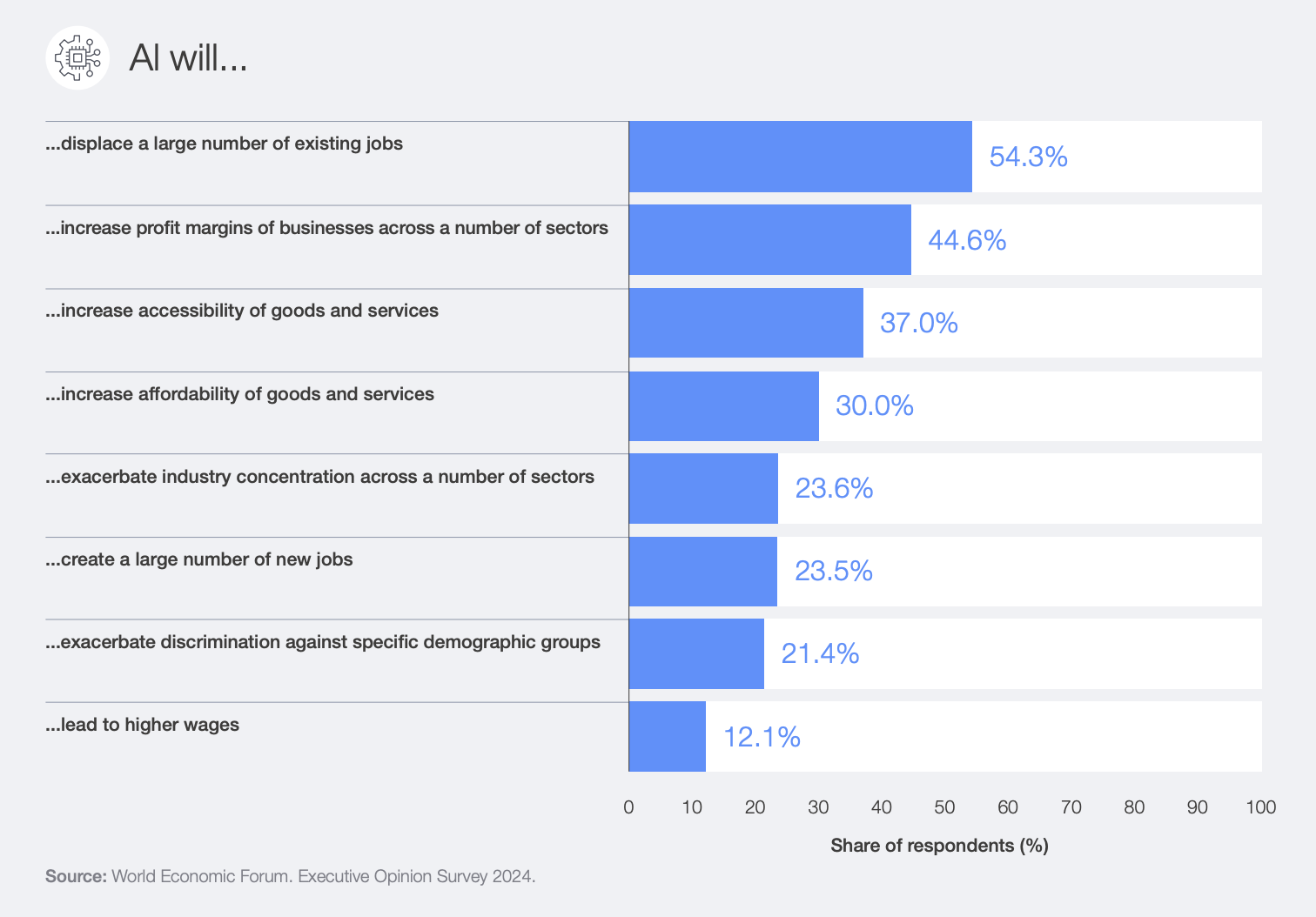
54.3% expect AI to displace a large number of existing jobs. 44.6% expect it to lift profit margins. Only 12.1% expect it to lead to higher wages. That’s a pretty stark picture of where the gains land and where they don’t.
The skills that actually matter, and the ones we’re underinvesting in
A separate WEF study released in December 2025 plotted the skills employers consider “core in 2025” against those they expect to grow in importance by 2030. It’s the single most clarifying chart I’ve seen on this topic in a while.
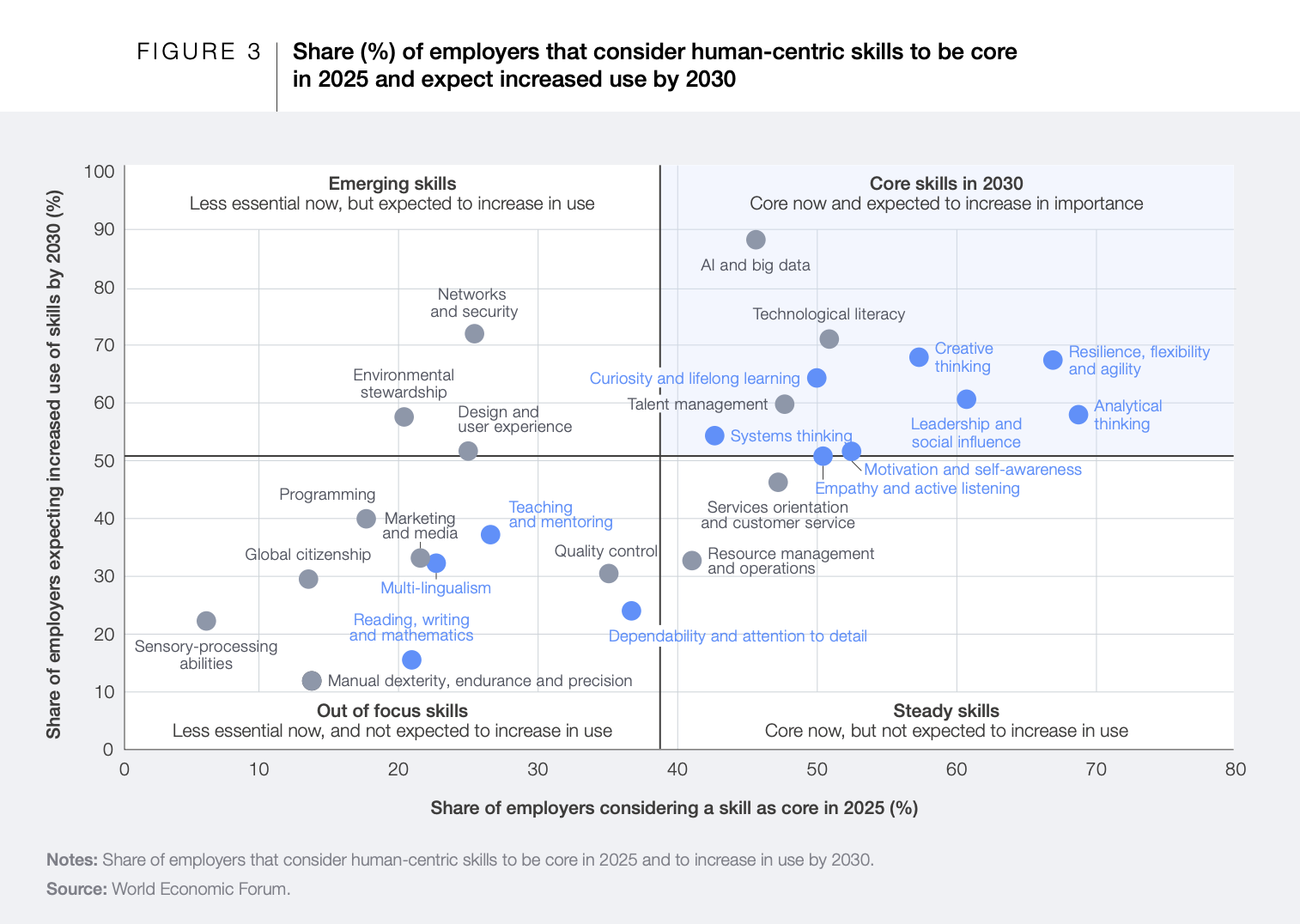
The top-right quadrant paints a very clear picture of what employers expect from the next generation of workers. Curiosity, lifelong learning, creative thinking, resilience, analytical thinking, leadership and social influence. A huge amount of mental and creative dexterity.
The striking thing, though, is how little stock is being placed on many of the human skills I hold to be incredibly valuable, and which genuinely underpin our societies and workplaces. Teaching and mentoring. Dependability and attention to detail. Reading, writing and mathematics. Services orientation. Empathy and active listening. All sit in the middle or lower-left… “emerging” or “out of focus.”
We cannot outsource a generation of brains to large language models. But we also can’t pretend those foundational skills don’t matter simply because employers aren’t prioritising them in a survey. How do you get curious lifelong learners without readers and writers? How do you build creative thinkers without teachers and mentors?
It’s a tricky tightrope to walk, and one that’s going to require serious thinking at a government level if we want to avoid a repeat of what happened with social media… where the tooling outpaced society’s ability to govern it, and the externalities landed on children.
Back to the vibecoded games
I made the decision to give my 9 and 11 year olds supervised access to Claude Code. I came up with what I thought was a fairly utopian framework. Each child had to first write down the brief for their game on a printed template. Name, theme, components, how you win, scoring, art style. The idea was to trigger and hone exactly the skills the WEF chart calls out in the top-right quadrant… systems thinking, analytical thinking, curiosity, structured problem-solving.
For a few weeks it went to plan. Nothing made it to a prompt until it had been through the intake process. We shipped some great little games very quickly. Some educational, some pure daft fun that the girls riffed together after school.
Then the rub came, pretty quickly.
Once both of them realised the power of the tool (they didn’t know the model name, but they knew how capable it was) they started looking for shortcuts. Why fill in the form if you can just iteratively riff your way to an outcome? Distracted by work, I noticed tokens burning through my Claude Max plan at an alarming rate, and half-baked game ideas making it “into production” that were never going to be decent, functioning anything.
Not a disaster. An interesting lesson. It turned into a really good conversation about why the process existed in the first place, and why cutting it hadn’t produced better games. Systems thinking, retroactively earned.
What I’m taking from it
I’m going to stay the co-pilot. Controlled access, structured intake, frequent post-mortems about what worked and what didn’t. My own experience with coding agents has been genuinely profound, and I feel convinced that with the right framework and governance we can prepare kids for some of the workforce shifts ahead.
With 54% of business executives predicting AI will displace a large number of jobs, it makes sense to train children on how to use it. But it’s just as important to pull the skills in the bottom-left of that WEF chart, the ones being quietly written off, up to the fore at the same time. Teaching, writing, dependability, empathy, attention to detail. AI is not going to develop those skills for us. If anything, it’s going to make them scarcer and more valuable.
So I’m taking the role of AI teacher and mentor for my kids pretty seriously. Also trying to enjoy the process, because honestly, watching a nine-year-old describe a bouncing-cat platformer and then deploy it an hour later is one of the more delightful things I’ve experienced as a parent.
The future of work in 2030 is still very much up for grabs. The WEF’s four scenarios are useful precisely because they remind us that the technology alone doesn’t determine the outcome. Workforce readiness does. And that starts a lot earlier than most people realise.
Charts and data reproduced with credit to the World Economic Forum. Full reports: Four Futures for Jobs in the New Economy (January 2026) and the accompanying WEF skills research (December 2025).