I spend a good chunk of my spare time teaching young people to sail at my local club. Sailing is counterintuitive at first. Almost all students understand that a boat can travel along with the wind behind it, but very few initially grasp how a boat can be able to sail upwind, that is towards the thing that’s meant to be pushing it along.
The longer I’ve spent on the water (getting my RYA qualifications, coaching, and honestly falling in rather a lot), the more I’ve come to appreciate the science and the art of it. And, unfortunately for anyone reading this, I’ve also built up a link in my head between something called the “points of sail” and the way the best businesses grow and ideas are born.
The points of sail
First a quick tour for anyone who’s never done it. Picture the wind coming towards you from twelve o’clock. You are standing in the very middle of the clock face.
Directly into the wind, which is from roughly ten o’clock round to two o’clock’, is called the no-go zone and you cannot sail there. Point the bow (the front)of a boat at the wind between these two angles and your sails will just flog. Sit there in it long enough you’ll get completely stuck which is also know as “in irons”… stopped dead, with no water moving over the rudder, so no steering any more either. You’ll be completely safe, but make no forward progress.
But as you bear away from the direction of the wind, start to move through the points of sail in turn. “Close-hauled” is as tight to the oncoming wind as a boat can point and still be able to move forward, typically around 40-45 degrees off it. Ease the angle out a bit further and you’re on what’s called a “close reach”, then a “beam reach” with the wind square on the side of the boat, and then a “broad reach” which is where the wind is coming over your back quarter. Keep on turning until the wind is directly behind you and you’re on a what’s called “a run”.
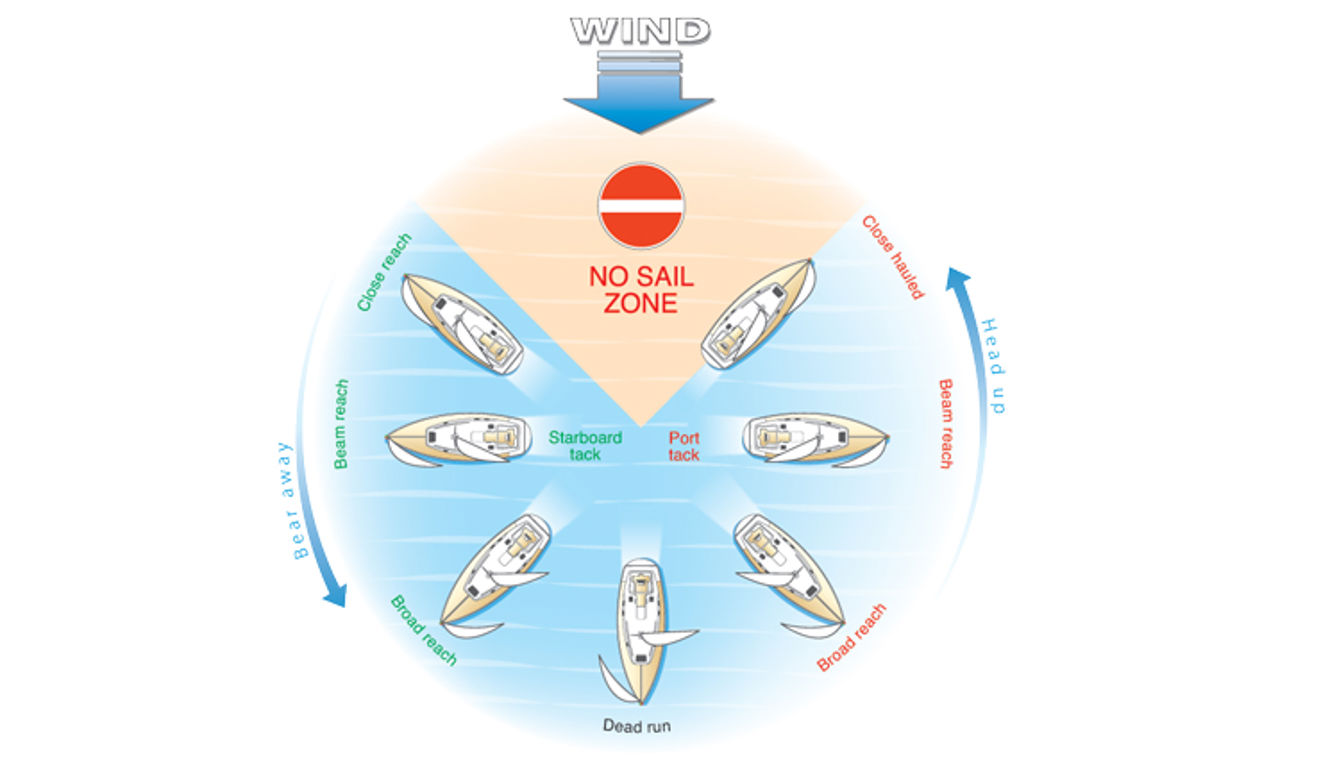
So that’s the whole clock face, and once we have learned that here is the question I put to every new learner…
Which one is the fastest?
Ask any first time sailor which point of sail is quickest and about nine in ten of them will say the run… The wind directly behind, everything will be pushing you forward. It feels like the obvious answer and I said the same thing on my first day.
It’s also wrong! The run is actually one of the slowest points of sail, as well as one of the twitchiest and most dangerous, but I won’t go into that here for fear of introducint one too many concepts 😂.
The fastest point of sail, for most boats, is actually the beam reach: wind square on the side, around 90 degrees off the bow. To see why, you need to understand the idea of apparent wind.
The concept of apparent wind
If you were to stick your hand out of the car window at 30mph on a perfectly still day you would feel a 30mph wind, even though the air itself isn’t moving. That’s wind you’ve made by moving through it. Now if you added a real breeze onto that, what you would feel is the two combined. On a boat the combined wind is what a sail works with. This is called apparent wind.
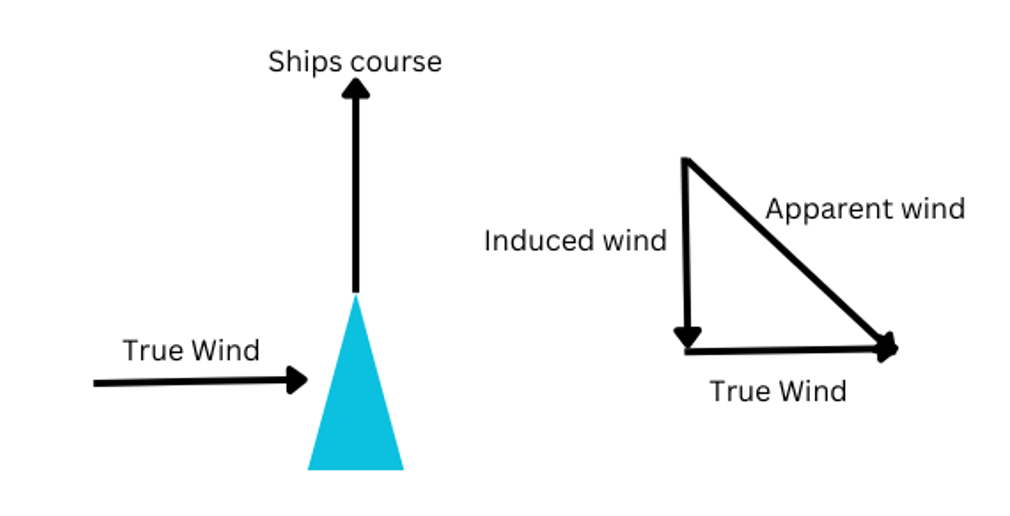
When sailing on a run you are travelling the same way the wind is going, so your own motion actually cancels out part of the breeze. The faster you travel, the less wind there is left to drive you forward, and you will never be able to outrun the speed of the wind that’s pushing you along. On this point of sail, the boat is reduced to catching air rather than working it or amplifying it.
On a beam reach, however, it flips. Your own forward motion adds to the breeze (just like in the car example) and pulls apparent wind round towards the bow of the boat. The sail stops acting like a parachute and now starts acting like a wing. It will actually generate lift rather than just catching drag, and the faster you go the more apparent wind you will build. This is is why a well-sailed boat on a reach can travel faster than the true wind. The America’s Cup and SailGP foilers are the most extreme illustration of this: catamarans that can clock several times the actual wind speed on a good day, by mutiplying the breeze through lift.
What on earth has this got to do with business, Tim?
The link I see from the combination of my observations over twenty-odd years in business and a few years messing about in boats is that the best initiatives, products, teams, etc have been born out of facing some element of challenge, not out of an easy following breeze.
The run to me represents the incumbent’s trap: wind behind, existing market dominance, everything apparently pushing you along, but ultimately no sense of speed relative to the water, and it doesn’t see the challenger coming.
Pointing dead into the wind is the opposite mistake: taking on the market head-on, no angle, sails flapping, and going nowhere. That’s a business in irons. Sadly I have seen a few of these over the years.
The fast position is neither of these. It’s the reach: sailing across the wind at a very deliberate angle, where you neither run from the conditions nor ram straight into them. You set an angle that turns the wind’s force into forward drive, and the harder it blows across you, the more of your own apparent wind you make.
Here’s a couple of examples…
Burger King, very much second in line to McDonald’s in terms of global market share, has consisentley turned that “disadvantage” into some of the most daring and technically inventive advertising over the past decades. Their Titanium-winning work at Cannes “The Whopper Detour” being the obvious high-water mark, and something we were lucky to be a part of powering at mParticle. Any market-leader coasting on scale doesn’t need to take these kinds of swings, because it has no reason to - everything to lose and nothing to gain. Whereas the challenger brand has every reason! This is a concrete example of great work born out of embracing headwinds and picking the best angle.
Similarly in SaaS, us being the challenger DMP at Krux back in the mid 2010s was exactly what fuelled us to take ground off Adobe and Oracle. We knew we were up against giants with more money, more logos and more relationships than we could ever match, but we also recognised that they were coasting on a dead run. They weren’t expecting to be overtaken by a startup, and we deliberately charted a course that attacked their enterprise market, feeling it would create a bigger opportunity for us and that we could outmaneuvre them. Looking back this pne makes me smile with regards to Oracle in particular, given Larry Ellison has spent an estimated $750m to $1bn on competitive sailing over the years!
Headwinds mean you’re in a real market
All of this is to say that I have come to treat headwinds as a good sign rather than a grievance. Regulation. Competition. Friction. These are all healthy tensions. In fact, if you find yourself in a sector or a product area that has no competition and no regulation to speak of, the truth is you’re probably not in a market at all.
The caveat to this is the one every sailor learns early. Being among headwinds is fine; being pointed dead into them is not! If you’re head to wind you’re going nowhere, and the only way out is to change tack, which in sailing sometimes means going backwards for a moment to get moving forwards again. Plenty of good businesses have had to do the commercial equivalent: give ground, reposition, lose a little way, in order to sail free again on a better angle. The clean room market is going through exactly this kind of repositioning right now.
Reading today’s wind forecast
Nearly at the end now, well done for hanging in there 😅.
I find myself coming back to the points of sail as I watch the AI narrative unfold. AI is clearly shifting both the direction and velocity of the wind. The prevailing direction is clear, but read any advanced wind forecast (h/t windy.com who I rely on each weekend) and you’ll note there can actually be a spread in terms of the number of degrees the wind might shift at any given time of day. It’s therefore not sensible to lock in on an AI is bad or AI is good stance. You rather need to be working to understand where your team, organisation, or product currently sits on the points of sail and to commit to an angle. I wrote about the same tension in a parenting context earlier this year.
Underneath all the theory, though, good sailing ultimately comes down to feel. You can learn the points of sail from a diagram in an afternoon, but reading the actual wind is a different thing entirely. The more hours you put in on the water, the more natural it becomes, until you find yourself sensing the shifts before they arrive and reading them off the water itself, off the ripples and the darker patches where a gust is about to land. You don’t get any of that from the clubhouse. You get it by being out there, often, and paying attention.
In an AI context, that means getting out on the water and starting to learn as soon as you can. Define discovery engagements that will move your business forward, rather than science projects that sit in a corner gathering dust. And accept that, much like me, you will probably fall in a couple of times early on. That is completely fine, as long as the programme is built around learning, discovery and progress, rather than one enormous bet that has to come off first time.
We think about it much the same way at Neuralift, and it is one of the reasons we settled on the commercial model we did right from the outset. We start clients with proof of value discovery engagements, so they can get some early wins on the board and see what their data actually holds. Consumption based economics come afterwards, giving customers the flexibility to scale as they find their own angle, rather than the rigid, all-or-nothing commitments that legacy software tends to demand.
See you out there.